
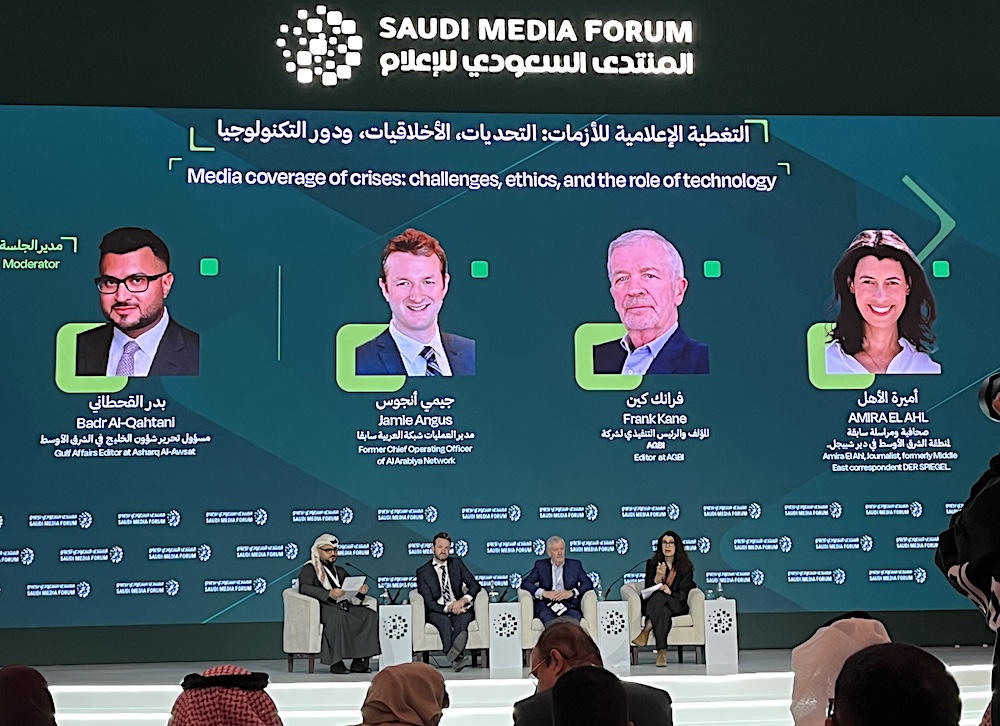
In a discussion with moderator Badr Al-Qahtani, the Gulf Affairs Editor of Asharq Al-Awsat, three seasoned journalists discussed the challenges of crisis reporting in the age of social media at this week’s Saudi Media Forum.
Journalist and middle east correspondent Amira El Ahl identified “who to talk to” as one of the big dilemmas she faces when covering a crisis. She has to evaluate the viewpoint and the biases of her sources to do her job properly. “Collecting the right information from the right people before writing the stories is the basis of good coverage. Today we have to be fast, but we should not neglect the core of our journalistic work. We have deadlines, but we have to balance these with accuracy. If I don’t have the facts I will not publish, even if I have a deadline.”
“From a technology point of view, another challenge is when the internet or facilities are not readily available, you have to know the technology well enough to work out how to file your story.”
Journalists must “dissect the complex reality” of what is happening on the ground during war or crisis coverage. “Detailed media journalism is needed to explain the complexities” behind those stories, which contrasts with coverage on social media, which is always quick and simple. “Social media makes complex stories seem simple, but that is not the reality of most crisis situations,” she said.
Jamie Angus, the former COO of Al Arabiya Network, believes that “in this digital world and social media space, news organisations that can do fact checking and verification at scale will remain important.” To retain credibility news organisations will need to show how they got the information and show people all the known facts.
“Many people don’t care and don’t check if a story they see on social media is true, but that undermines the value of real news. We should continually argue our case for credibility,” he said.
Frank Kane, the Editor of Arabian Gulf Business Insight, says covering crises “put a huge drain on media organisations and journalists.”
He quoted two old journalistic truisms: ‘Journalists write the first rough draft of history’ and ‘the first casualty of war or truth.’
“As journalists we have a responsibility to report the news accurately and ensure that that nothing we do inflames the crisis. It is probably better to be second and to be right, than to be first and to be wrong,” he said.
AI is ramping up the risks of fake news being created and spread faster and further than ever before. He quoted the example stock prices falling in response to the DeepSeek launch. To test his views on AI, he asked DeepSeek ‘did you provoke the financial crisis?’ The AI engine responded: ‘my memory only goes to 2023, so I could not have possibly caused it,’ was the answer.
“Before social media we were the gatekeepers. In the pre-digital era a small number of people would have made decisions about what was appropriate to publish. We tried to exercise that responsibility in good faith. That has been completely blown out of the water, I’m shocked every day at what is on social media sites without any warnings.”
The instant ability to publish on social media without any editorial checking causes confusion and is one of the factors leading to the decline of trust in news, according to Kane.
“People say I don’t trust the established media because they think we are hiding things. They can see pictures of dead bodies on their phones, but media is being careful of showing bodies to protect families from seeing dead relative or showing shocking scenes to children without a chance for parents to turn it off. We are not hiding the truth but we are exercising responsibility about what we publish to avoid harm,” said Kane.
El Ahl agreed, noting she has “a responsibility to tell people’s intimate stories with respect and dignity, not just trying to publish something for clicks or popularity.
“The publishing process had strict publishing checks in the past, citizen journalism bypasses this. It is not edited or curated, that often means that it can be wrong. We need to re-apply the old principle of verification, but use all the new techniques.”
The ability for AI to generate almost indistinguishable fake images in real time is a challenge according to the panellists. They argued for credibility labelling, more media literacy for the audience and engaging reporting that helps audiences to understand complex stories.
“There is no way to put the genie back in the box, AI is here and we need to make the most of it. But remember that AI can make mistakes, so it needs to be fact checked too… Don’t be confused, AI throws so much information at you that you have to learn to deal with it and not be overwhelmed.”
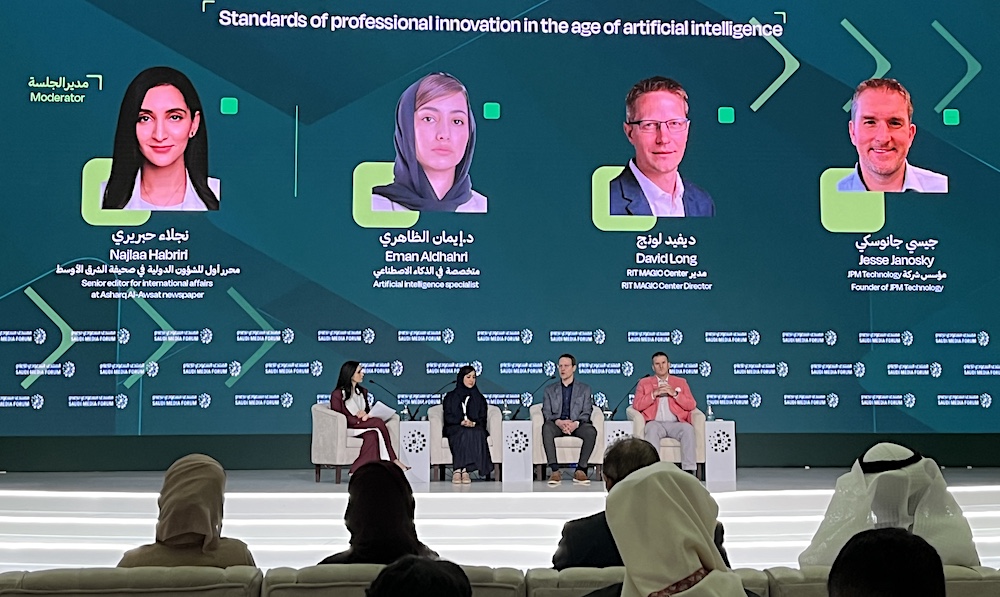
In another session on AI, three speakers came from a variety of perspectives to analyse artificial intelligence in journalism: training, production and ethics.
Jesse Janosky, from JPM Technology, says automation of spreadsheets and documentation of daily work is easy with AI, but when you get to more sophisticated uses you need to think carefully about the way you prompt the AI engine. “Define your overall preferences with a big picture prompt, for instance ‘explain to me like I am a third grader’ for topics that you are not familiar with.”
Another tip is to “be wary of relying on just a one sentence answer from the AI, it will be too simplistic.”
David Long, the Director of RIT Magic Centre says “there is a big difference between productivity tools and generative tools.”
AI can be useful for setting up post production tools. “There are so many technical things at the beginning of each project that need to be calibrated, very tedious setup functions that could not have been automated previously can now be handled by AI. For example, building a foreground scene, or cleaning up background audio, applying compression or the clean up of performance capture data.”
Generative tools are being used to prompt creativity, but not to take the place of the creative process.
AI specialist Eman Aldhahri talked about standards and ethics for using AI in journalism. “Sometimes the AI model can pick up human bias from its training, it is our responsibility to check the AI before publishing. Be aware of AI biases, it can only be as good as the data pool it is drawing from.” Eman also reminded attendees of the importance of following the principles of intellectual property.
Two other draw backs of then current generation of AI are that it still has trouble with generating realistic voices and that AI generated pictures are never as crisp as real life.
“The random nature of it can be embraced if you are comfortable with the ‘happy accidents’ that occur from the AI.”