
Article by Caroline Grazé, Radioplayer.
For many years, digital discovery followed a relatively simple pattern. Users searched for information, reviewed the results, and actively chose what to access. That model shaped how broadcasters approached digital distribution. Websites, apps, and search visibility became essential parts of how audiences discovered radio content online.
Voice is now changing that model.
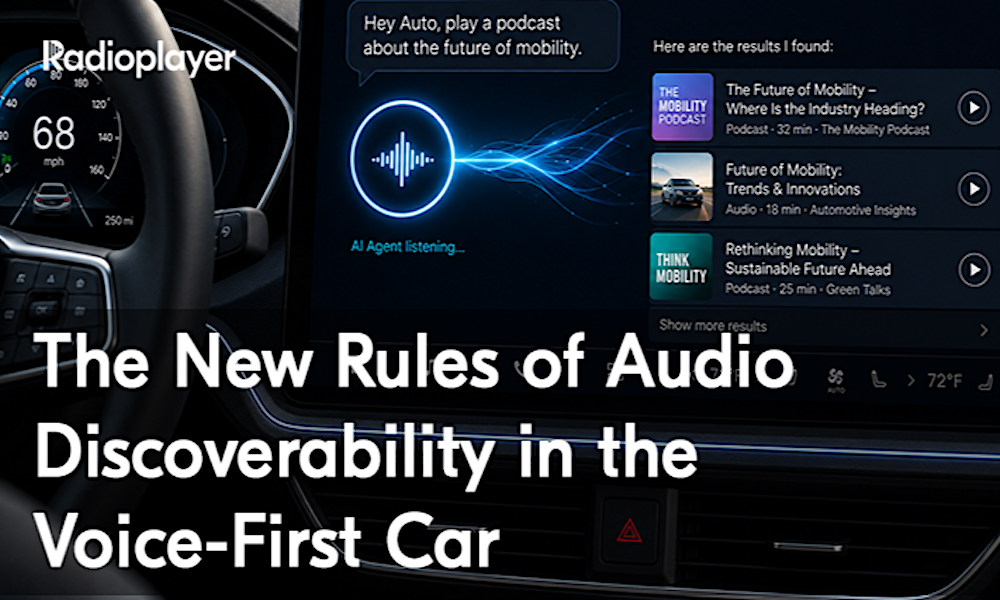
Voice assistants are evolving beyond simple command-based smart speakers into more conversational interfaces that increasingly shape how users access information, media, and audio content. Instead of searching, browsing, and clicking, users are gradually becoming more comfortable asking for content directly and receiving immediate answers or playback.
For broadcasters, this creates an important shift in how radio is accessed. To be found and discovered, the content needs to be even more structured and contextualized.
Across homes, cars, and connected devices, voice assistants are becoming a natural part of everyday routines. As we move from “switch on the light” to “play me some energetic rock music with local, hourly news”, voice becomes less of a device feature and more of an access model.
For radio, this creates both opportunity and challenge.
The opportunity is clear. Voice aligns naturally with many of radio’s strongest characteristics. Radio is live, immediate, and simple to consume. Voice can make access even easier by reducing friction between the listener and the content. Asking for a radio station is one of the most natural use cases for conversational interfaces.
At the same time, voice creates new challenges for discoverability.
If radio content is not properly structured for voice environments, it becomes harder for systems to understand, surface, and deliver it accurately. In traditional digital environments, discoverability often depended on visual navigation. Users could browse apps, scroll through menus, or search manually. Voice changes that dynamic by not only removing much of the visible interface layer but also by limiting the result, thereby placing greater responsibility on structured and contextual data.
This also changes where control sits.
In traditional digital environments, broadcasters had clearer ownership over how audiences navigated their content. In conversational environments, that journey is increasingly shaped by third-party platforms and interface logic. That creates a new dependency on how those systems interpret and prioritize content, making it even more important for broadcasters to strengthen the data and structures that help preserve visibility and accessibility.
This makes the quality of the underlying data far more important.
Metadata has always been part of digital radio distribution. Station names, program titles, schedules, and content descriptions all help support visibility across digital platforms. But in voice environments, metadata becomes much more strategic because it helps machines understand what content exists, how it should be categorized, and when it should be presented in response to user requests.
When a listener asks for a station, a program, or a type of content, voice systems rely on structured data to interpret that request correctly. If that structure is weak, incomplete, or inconsistent, radio becomes harder to access.
This means broadcasters need to think differently about discoverability.
It is no longer enough to simply publish audio streams or maintain a digital presence. Content increasingly needs to be organized, described, and maintained in ways that support machine understanding. That includes richer station metadata, stronger program-level information, and clearer relationships between live content, on-demand content, and station brands = context.
As this shift extends beyond smart speakers and affects connected cars, mobile apps, and the wider ecosystem of connected devices where voice is becoming an increasingly important way of accessing audio content, broadcasters need to think about consistency across all these environments.
So how do broadcasters ensure radio remains easy to access in a world where interfaces are becoming increasingly conversational?
As context is key, the priority is to ensure the metadata’s quality and structure. Station names, program titles, schedules, logos, artwork, and live content information need to be accurate, consistent, and regularly updated. That’s the basic entry level. Next comes structure: Beyond the audio stream itself, the content and all its affiliated information need to be clearly organised and connected. Above all, voice systems need not only to understand what content is available, but more importantly, when it is relevant. Adding contextual information to the basic metadata will be key to providing that information.
By doing this and ultimately controlling the digital access points across the platform where audiences listen, broadcasters can ensure the optimal outcome. As a bonus, it also reduces friction, strengthens reliability, and helps maintain stronger brand control.
That means Radio itself does not need to change. Its strengths remain the same: live content, trust, immediacy, and human connection. But the way listeners reach the radio is changing, and broadcasters need to adapt to that reality. Those who invest in stronger metadata, better content structure, and cleaner digital distribution will be better positioned, simple to find, and easy to access.
At Radioplayer, the central part of our work is to give broadcasters the proper tools to do exactly that: Through Radioplayer, stations can manage and update all the static and dynamic metadata that powers their presence across connected environments. For voice, we gradually increase the contextual data and co-feed it with data from our insights portal to optimize significance for the systems, relevance for the listener, and ultimately reach for the broadcaster.
Unlike other aggregators and 3rd party platforms, Radioplayer is not only about distribution but mostly about control. Control over how stations appear, how content is structured, and how radio and audio is discovered across increasingly connected media environments: Voice assistants, connected cars, apps, and other digital platforms.
This matters because radio’s strength has always been simplicity. For listeners, radio should remain immediate, familiar, and easy to access, regardless of the interface being used.
Voice has the potential to strengthen that simplicity, but only if the technical foundations behind it are strong enough. With voice, discoverability becomes more than a technical issue. It becomes a strategic one.
About the author

Caroline Grazé is Managing Director of Radioplayer Deutschland
AI Disclosure: AI was used to create the main graphic, supplied by Radioplayer