
It is Media and Information Literacy week, a UNESCO initiative to make the world aware of how important the media is in communicating truth and factural reporting.
Media and Information Literacy is “key to address the challenges of the 21st century including the proliferation of mis- and disinformation and hate speech, the decline of trust in media and the transformative impact of digital innovations notably Artificial Intelligence,” according to UNESCO.
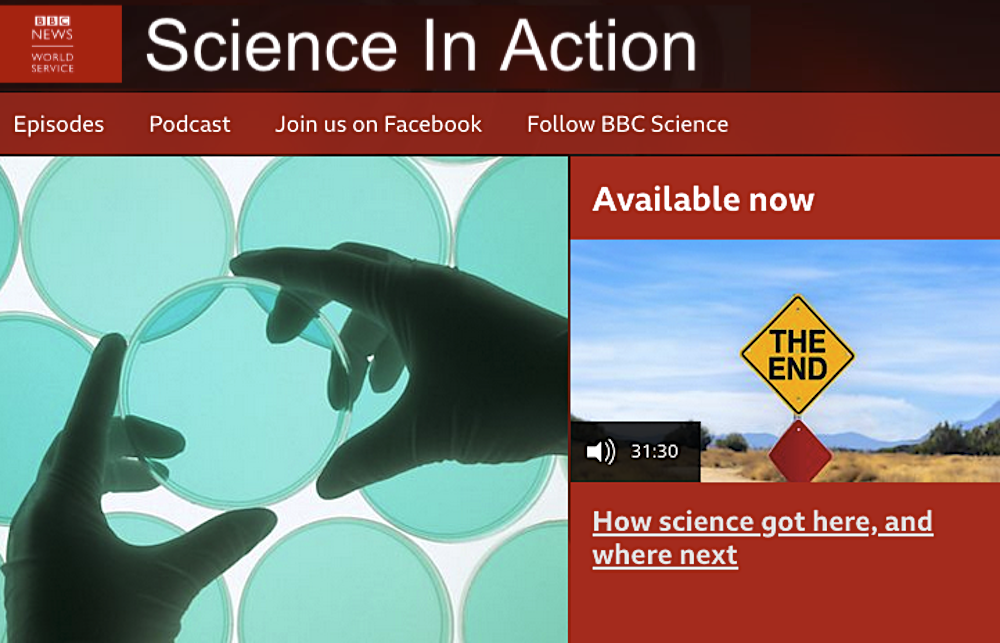
Ironically, a flagship BBC program, Science in Action aired its final episode this week. The episode featured a discussion on mis-information and the erosion of trust in evidence based science.
Presenter Roland Pease and guests Michael Mann, Naomi Oreskes, Angie Rasmussen and Deb Houry considered the question: does evidence-based policy in a scientific society have much of a future and discussed some of the sources and motivations of anti-science misinformation purveyors.
Elsewhere on the BBC World Service, The Interview show featured MIL topics in two notable interviews, one with author Philip Pullman and the other with Wikipedia founder Jimmy Wales.


Pullman’s His Dark Materials series featuers the alethiometer, the ‘conveyor of trth.’ He told Katie Razzall: “The coming of the internet and social media has made truth harder to grasp because then authorities you used to turn to, dictionaries, encyclopaedias, are either not used at all or mocked as being purveyors of something patriarchal or old fashioned.”
Wales believes “we’re living in an era of a massive lowering of trust.” He spoke to Shaun Ley about how to trust in a digital age, the pressures facing open‑knowledge platforms and his new book The Seven Rules of Trust.
In the last Science in Action program, Roland Pease opened by recognising the show’s long history:
“Science in Action first aired here on the BBC World Service in November 1964, a time of great optimism… But we’ve been covering the dark side here too. Global warming… deforestation, extinctions…and particularly since the pandemic, science has been a bit on the defensive to the extent that America’s highly regarded health institutions are now run by anti-vaxxers and virus skeptics, and environmental centers are in retreat. I’m Ronan Pease, and this is the last episode of Science in Action in a Much More Uncertain Age. How did we get here and how can we restore confidence in science?”
Opinions offered by the guests included:
Michael Mann: “Science is indeed under siege. I did see this firsthand two and a half decades ago when my co -authors and I published The Hockey Stick Curve. It laid bare the reality and threat of human-caused warming so it came under attack by the bad actors… fossil fuel interests, petrostates, plutocrats, who have tried to undermine public faith and science. Many of the same players, interestingly, who were involved in the anti-science assaults on COVID messaging of the public health community, anti-vax messaging, and the assault on wearing masks and social distancing… we realized that we had a book to write because, indeed, even though these are two very same issues and they’ve played out at very different times, there really is a commonality. And that commonality is that they’re powerful, vested interests who find the science inconvenient and have used the tremendous power and wealth and influence that they now have to undermine public faith in the science itself, with disastrous and deadly implications.”
Naomi Oreskes said: “It’s really the same thing that’s in it for the people who deny climate change. It’s money and it’s power. Essentially, people who are saying don’t take vaccines, they’re bad for you, always have some kind of alternative to offer in place of those vaccines… [or criticising] the bad actors in government who are trying to control your lives through these public health measures that are actually designed to protect people and to preserve public health… because that is the government’s role.”
The BBC has not abandoned the coverage of science, a new science show will be introduced next month.
“In a fragmented, polarized and distrusted information ecosystem, MIL has become a crucial skill for the fate and future of media,” says UNESCO. It encourages media to join the campaign and mobilize its readers. Every year during the same week, stakeholders around the world organize events and UNESCO co-hosts with a Member State the global conference gathering the MIL community, this year it was in Brazil. This year the focus was on AI.
New research coordinated by the European Broadcasting Union (EBU) has found that AI assistants – already a daily information gateway for millions of people – routinely misrepresent news content no matter which language, territory, or AI platform is tested. The intensive international study of unprecedented scope and scale was launched at the EBU News Assembly. Read the report here.
In recent years, the ABC has covered MIL, see its media literacy information page here, and last year Australia’s national broadcaster released this guide to media literacy. This week Friends of the ABC organised a talk by investigative journalist Paddy Manning on media and information literacy to mark MIL week.
Have you covered Media & Information Literacy in your programs or podcasts? Let us know at [email protected] and we wil add your information to this report.
Main graphic: BBC/GettyImages