
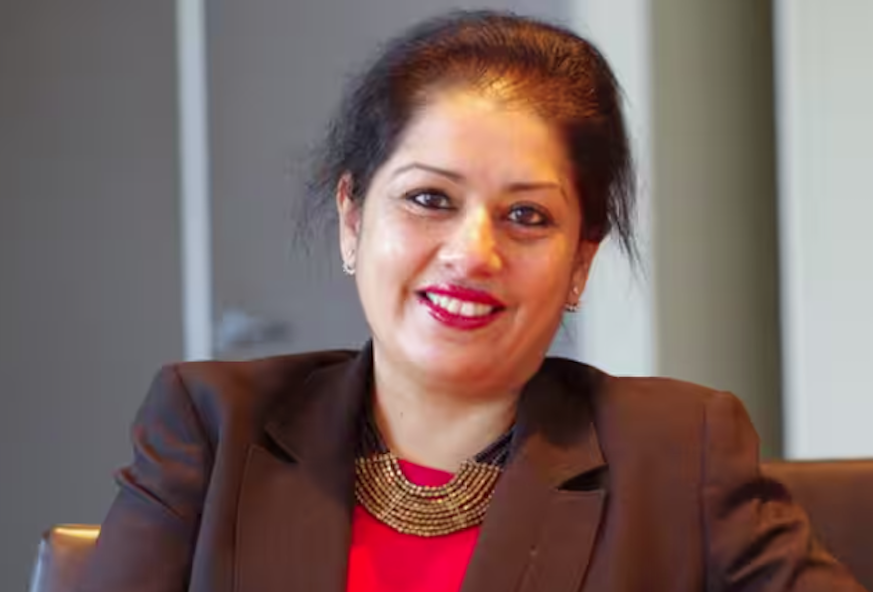
Manpreet Kaur Singh is Program Manager for SBS Audio at Australia’s specialist national broadcaster, SBS.
In this profile, Manpreet reflects on the wisdom she has gained during her career journey. It is part of a series in our Australian publication exploring the career and life journey of women in the media industry.
Manpreet overcame the challenge of many rejected applications when she moved to Australia, before finding her first part-time role in the radio industry. She tells her story and shares her wisdom with Serena Ahern.
Describe your current professional life and your stage of life
I’ve been in the media industry for 36 years now, almost 33 of them at SBS. I started out in 1989 as a print journalist and a television presenter in India and ‘discovered’ radio for the first time after migrating to Australia in 1991.
In my current role as Program Manager at SBS Audio, I oversee the editorial output of several language teams within the SBS South Asian channel, serving Australians who speak languages from India, Pakistan, Bangladesh, Sri Lanka and Nepal. I’m very fortunate to be leading some amazing teams as they produce fantastic audio, video and online content, connecting meaningfully with our audiences, telling stories that need to be told with cultural sensitivity, and which may otherwise never be covered in mainstream media.
Personally, I started at SBS Punjabi in 1993 as a broadcaster. I remember playing with those spools – you’d physically load them up and put little marks on the tape so you’d know where your interview was! Back then, there was no internet or satellite television, and our in-language broadcasts were probably the only window that made our audiences ‘feel at home’ in Australia.
Simply hearing a familiar language on the airwaves forged a sense of identity for many new migrants – I know for a fact that several audience members taped my one-hour broadcast to hear it on repeat until the following Thursday night, when the next program would be aired. It’s been quite a journey from those times, evolving and growing to the modern era where everything is now digital – now, we are on every platform that our audience chooses to be on.
During my 27 years as Executive Producer of SBS Punjabi, my work revolved around serving the community in the best way possible. It was about showcasing their successes, and shining a spotlight on their challenges, especially on issues like family violence in the Indian community. My greatest passion was pursuing investigative stories, often taking months to delve deeper to talk about things that really mattered, whether it was covering the history of Indian arrival in Australia, or surfacing stories of multiculturalism and social cohesion, or stories about social justice and community issues.
In my current role though, I oversee the on-air and digital content produced by my Bangla, Gujarati, Hindi, Malayalam, Nepali, Punjabi, Sinhala, Tamil and Telugu teams. I’m also privileged to have launched SBS Spice, a brand new offering in English for young people of South Asian heritage in Australia. All of this content has a home in the 24/7 channel, SBS South Asian.
How did you come to be in this industry? Was it a childhood passion or a series of accidents?
A bit of both, in the sense that I always knew even when I was studying in grade 2 or 3, that I wanted to be a writer when I grew up. So even as a child I knew where my passion lay. In India, that dream come true quite easily – I was still doing my post grad degree in journalism when I was handpicked from my class to start writing columns for Indian Express, a very popular national newspaper. I also worked with another well-known broadsheet Hindustan Times – to which I contributed quite regularly even after moving to Australia – in addition to being on the only national television broadcaster in India back then, Doordarshan. I was pretty much invited to work on Doordarshan without even applying for a job there!
I enjoyed a fairly successful career as a young journalist back home, and was even offered a chance to work in Bollywood! As an arts reporter, I interviewed this film director who really wanted me to star in his film – he even arranged for me to be trained as an actor, but I’m so glad I didn’t go down that path.
Life changed pretty quickly for me in 1991 – I got married and since my husband was already settled in Australia, I moved here. Then came the big challenge for me, because I applied for jobs everywhere, without much luck. It was very frustrating when the first question every prospective employer asked was, “Do you have experience of working in Australia?” It was a catch-22 situation.
The pivot to working in-language came when SBS Radio had a vacancy in its Punjabi language service. I’d never done radio before and had never worked in-language professionally, even though Punjabi was my mother language. It was a big change for me – a happy accident that gave me a break in journalism in Australia.
I count myself very lucky to land that role at SBS, because it came after an almost soul-destroying experience of not being able to find a suitable job for almost two years as a new migrant in Australia. SBS provided me with the opportunity to pursue my passion which among other things, led me to win several national and international awards, for which I feel very privileged and grateful.
I took almost a year to produce an audio documentary called The Enemy Within, which examined the prevalence of family and domestic violence in Australia’s Indian community, taking care not to blame the community or culture, but to dissect why and how it manifests. I spoke to survivors, family members, police, social workers, and other stakeholders to understand the causes, taking care to define what constitutes family and domestic violence, because migrants coming from other parts of the world could be unaware of its definition under the Australian law. I asked experts what can be done in the prevention space and to offer support, and also to refrain from victim-blaming, which unfortunately happens a lot.
The Enemy Within was a Walkley finalist, and went on to win the UNAA Media Award, the New York Festivals, the Legal Reporting Award, and several more in Victoria and New South Wales.
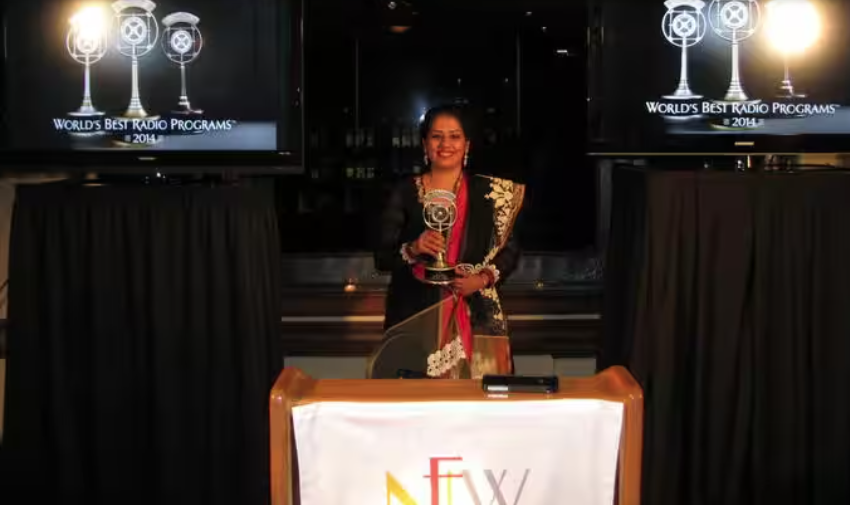
Manpreet receiving the silver trophy at New York Festivals for World’s Best Radio
I also embarked on an investigation, looking at the quality of foods imported into Australia. The results were rather shocking, because some imported spices, rice, ghee, flour and even baby cereal fell well short of Australian food standards, with some foods found to be containing banned substances and carcinogens. All of these investigations are available online.
SBS has afforded me some amazing opportunities to do some powerful investigative stories, which many in my audience tell me, have made a difference.
What are your core beliefs and how are your values are evident in the work you do in the life you lead?
One of my core beliefs is to always pursue the truth. Be very curious to dig deeper, to not be satisfied with what’s obvious – so scratch beyond the surface until you uncover the full story. Be honest, be balanced, and always be fair while reporting. You need to have honesty and authenticity within you – ask the right questions without actually having an outcome in mind. Also, there’s absolutely no substitute for hard work and no short cut to success.
And speaking of core beliefs, I’d like to speak of some that have been ingrained in me since childhood. There are two words which I will speak in my mother language – one is Nirbhau and the other is Nirvair. The first word means “fear nothing” and the second one is “you’re against no one, and no one is an enemy”. Those two things are fundamental to defining who I am and have been my journalism mantra -pursue stories without fear or favour. That’s something I still tell my team, that our work can’t be influenced by fears or favours.
How did your informal education enrich your career /life journey and it would be a good time to also talk about any mentors or even any detractors?
Working in the public eye gives you many crowns to wear, with a few thorns among the roses. A majority of the people in the audience express love and admiration, but every now and then you, do have the detractors. How they form and shape you, I’ll discuss later.
Let me first talk about how informal education influenced me. My father worked in the Indian army which meant that every two years he was posted to a completely different part of India. It was like going into a new country with a new language, new culture, new food, lifestyle, weather, language and festivals. Growing up, I attended seven different schools until I completed Year 12.
It instilled a sense of respect for difference in me and also a lived understanding that fundamentally, everyone is the same, despite the overt differences. The constant moving also meant I learnt to fit in easily, which I still regard as my biggest strength.
I think that’s what sustained me when I first migrated to Australia. Australia in 1991 was very different to today’s Australia – back then, we were infamously living through “the recession we had to have” and jobs weren’t easy to come by. I don’t think there was any name like mine in the mainstream media, or people with my face colour or my background. I really didn’t see myself represented anywhere.
I would have applied for about 140 jobs, and most employers didn’t even consider me an applicant worth interviewing. Even though I had the skills and experience of working in India, no media organisation gave me a second look for two years. I was invisible and it was an extremely difficult experience. I fell back on my childhood experiences of just wanting to remain authentic and finding a way forward. I feel so lucky that this break at SBS came when it did, and the rest is history.
I took the leap to work in radio and in-language journalism for the first time – it was a part time job and here I am 33 years later, leading a 24/7 channel serving the South Asian communities around the country. I sometimes pinch myself to make sure this is really true, because the Manpreet who landed in Australia in 1991couldn’t have dared to dream that this within the realms of possibility!
And did you have any significant mentors along the way?
Not at the start, and it was really hard to navigate my own way in a new country and a new media landscape. But I tried to learn something – however little – from everyone I met. Of what to do, and importantly, of what not to do.
Later in life though, I was very lucky to have a mentor who truly believed in me. I regard Maurizio Pascucci as that mentor who inspired me to pursue my best work whilst he was my manager. Apart from supporting me immensely as an editorial sounding board, he taught me to always make positive assumptions, to be fair and equitable, to be open-minded, to tackle the issues and not the people, whether as a journalist or a manager. He’s now retired from SBS but is still a very dear friend and I count him as one of the people who absolutely believed in me and inspired me to achieve.
As far as the detractors are concerned, I have my fair share of them, I guess. In-language journalism gives you great proximity to the community and whilst many listeners make you feel like you’re part of their family, it can also lead to some very serious situations.
For example, as a female journalist covering stories of family violence within your community, it is easy for perpetrators to treat you as fair game, and to take you on as well. Unfortunately I’ve had a series of those kinds of threats which were rather serious, because perpetrators don’t like to be called out. I had to seek intervention from the police and needed security to deal with those situations more than once – perhaps a price to pay, just for doing my job well.
One deals with it in the best way possible, because you know within that you didn’t do anything wrong. You don’t stop the good work even when threatened.
It’s very brave to continue doing your job in the face of threats.
Well I was on the media advisory group for “Our Watch” as the SBS representative and I met a lot of journalists from various media organisations who’d been trolled relentlessly, just for doing these kind of stories. We were featured in a video when reporting on confronting stories, as an educational resource for other journalists.
I guess what inspired me to continue doing my work was the feedback from the victims and survivors – how they were empowered after being interviewed on SBS. Many have shared how their lives have been rebuilt after speaking out, and that is a great motivator. Ultimately, we’re in this business to do what’s right, especially by the community.
I believe if you’re doing the right thing and are supported by your organisation, you continue on that journey. There will be some brickbats of course – you can’t just always have a bouquets coming your way. So you just take it in your stride and continue your good work.
What are some of your key decision change points and how did they shape your career life journey?
Haha! I’m glad I didn’t choose Bollywood over journalism! And I’m also glad that in-language journalism chose me in Australia, because it’s not something I would’ve pursued had I remained in in India.
By connecting to my roots, through working in-language and getting close to the community, has shaped my journey and brought me here. I’m very grateful for those opportunities and experiences and feel very lucky to be in this current role. My language teams serve around 1.5 million Australians of South Asian heritage, and that’s a huge privilege.
I’m proud that we’ve recently launched SBS Spice. It’s an experiment within SBS Audio where we’re reaching out in English for the first time, but speaking to the diaspora, to the young South Asians who may not speak in-language, but they have a shared culture, similar upbringing, relatable lived experiences and we try to bring that together on Spice.
I feel really proud that I was given a clean slate to come up with a concept, the content plan, recruitment and implementation of this idea. Spice is doing some amazing work and I hope it continues to serve the next generations.
It also sounds like a wonderful opportunity for collaboration with the community too.
Also to reach out to the younger audiences who may not necessarily connect with our in-language offerings. It continues to be that safe, shared space for younger audiences to come together and talk about pop culture, what makes them click, identity issues or relationships. We’ve been able to lay a strong foundation for meaningful storytelling in a fun way, something which had not been attempted before.
What makes you happy? What makes you get up in the morning so you’ve partly answered that by talking about creating wonderful programs like Spice.
The possibility of serving our audiences better everyday and supporting my amazing language teams in telling stories that wouldn’t otherwise be told – that’s what makes me happy, because we provide cultural expertise, give a platform to the under-represented and prioritise diversity of voices. That’s what makes me get up in the morning.
Currently, what’s got me most excited is leading SBS Audio’s community pillar Diwali project for the fourth consecutive year. For SBS, Diwali is key pillar moment in the annual calendar, during which we engage extensively with the community, especially in regional areas. We inform and educate our audiences about the diversity of the festivals of lights, known variously as Diwali, Deepavali, Bandi Chhor Diwas and Tihar, and celebrate with our communities around Australia.

Is there anything you do for yourself personally that gives you a boost? Like a wonderful walk? Time by the ocean?
All of the above. Recently, my birthday fell on the night of the lunar eclipse and the blood moon – I was out there watching the celestial show at 2 am in the morning! I also like to watch the sunrise, going out for walks and connecting with nature. Travelling and connecting with family overseas also rejuvenates me.
I think ultimately my core identity is that of a proud mother and a loved daughter. I have three beautiful, amazing children and they’re truly the centre of my universe. They’re all grown-up now and working jobs in fields they love. And as a daughter, my father is the one person who has truly given me wings, been my safety net and my biggest cheerleader. These are the relationships that energise me the most.
Share your words of wisdom for others in the industry or those wishing to work in the industry.
Be authentic, be yourself, because only you can be the best version of yourself. Don’t try to be someone you’re not.
Always put the audience first, that’s really important. Make sure you ask the questions from the perspective of a listener, or a reader, or a viewer.
Do your due diligence, however long it takes. It’s important to be accurate, not first.
And no half-baked ideas please, always cross the ‘i’s and dot the ‘t’s
Back yourself and be prepared to face the challenges. Let’s be real, of course there will be challenges.
Welcome complaints and criticism as they are opportunities to learn and grow.
Surround yourself with mentors, people who support you, who will believe in you and who will give you honest feedback.
Have fun. Journalism is often a very serious business, but it’s important to step out of the comfort zone, do something different. For example, I’ve been an in-language commentator for AFL for several years. I had to learn so much about footy before taking the plunge, but had so much fun doing it.
Describe your vision for the audio media industry in the near future.
There’s so much talk about AI and what’s going to happen in the future, but I remain very optimistic. We heard a lot of these rumblings when television came in the mid-1900s, that radio wouldn’t exist anymore. Then the internet came and social media took over, sparking concerns that traditional forms of media will become obsolete.
Technology will keep throwing new challenges and changes will keep coming, we in the media just have to keep evolving with it.
My vision is that audio consumption continues to grow, because I really believe that sound is a wonderful and intimate way to connect, perhaps even more powerful than visual media. I think a voice stays with you, whilst leaving space for imagination, the emotion stays with the listener for a long time. So we can explore stories with a lot more depth in audio, whereas visual media need a lot more production value-add for long format.
I think the future holds unlimited possibilities as long as we use AI diligently, and to our advantage. With human oversight, I believe audio has plenty of scope to grow, especially with in-language offerings. I would love to see more podcasts and more meaningful journalism to continue, especially in-language.
What role would you like to play in shaping the audio industry of the future?
I just hope that I’ll continue to be here for a few more years and help our teams in their evolutionary journey to reach more audiences on more platforms. I hope we continue to inform, educate and entertain, as well as reach out to young audiences and really understand what they want. We would need to make sure we are pivoting, serving those younger audiences so that they stay with us. I hope more people take to podcasts and discover the magic of human connection through audio.
On reflection, it feels like we’ve come a full circle. When I first started out at SBS we simply focused on community stories, nothing too fancy. There was no printed version of the broadcast published on a website, no podcast or streaming, catchup or digital radio. Once broadcast, the content disappeared into the ether, but left an indelible impression on the audience because of the emotional connection with those who consumed it. As audio journalists, the connection with community will be what differentiates us from AI-generated content.
I hope I can continue to inspire my teams and other young journalists to connect authentically with the audiences.
Is there anything else you’d like to add?
I’m very lucky to have had the opportunity to work in this meaningful profession, but the pathway wasn’t all that easy. So I guess the only thing I want to say to young aspiring journalists is, don’t give up or feel disheartened and don’t be afraid to reinvent yourself especially when you don’t find the first break. Continue to look for opportunities and don’t be afraid to change tracks or pivoting to something you’ve not tried before in order to get a foot in the door.

Series compiled by Serena Ahern for radioinfo.
If you have a suggestion for someone to be considered for this series, please send a note to [email protected]
Previous articles in this series:
Wisdom of Women in Media: Cheryl Lee Co Founder and Manager Rebel Radio Network
Wisdom of Women in Media: Rebecca Ackland Chief People & Culture Officer SCA
Wisdom of Women in Media: Helen Tzarimas News Reader and Journalist Gold 101.7
Wisdom of Women in Media: Amanda Lee, Head of HIT Metro Content/Fox FM Content Director
Wisdom of Women in Media: Kim Napier, Breakfast Presenter ABC Northern Tasmania
Wisdom of Women in Media: Megan Smith, Senior Producer Gold 101.7
Wisdom of Women in Media: Laura Bouchet, Content Director Triple M
Wisdom of Women in Media: Lauren Joyce, Chief Audience & Content Officer ARN