

Steve Ahern reports from the IBC Conference & Exhibition in Amsterdam.
The rain cleared and a rainbow appeared above the conference complex in Amsterdam at the beginning of the first IBC conference day.
So I went in search of the gold at the end of that rainbow. I found some.
My top trend today is: Using AI to grow your business
Using AI to cut costs is so last year!
In the past 18 months since AI tools emerged, the business focus was first on using AI to cut costs. That has been only marginally successful.
Audio and video media business leaders I have spoken to at IBC so far have told me they used AI to cut costs, but that had limited success after the first initial expenditure reduction. While costs were cut, sometimes the level of service and professional interaction inside and outside the business was adversely affected.
Good results were achieved in:
- Simple production processes such as editing, content cleanup and indexing, but the complexity of using multiple AI tools for more complex tasks was felt to not yet be up to scratch.
- One of the best efficiencies identified was the ability to find segments in radio and tv programs using AI word searches, rather than spending time listening/watching through whole shows to find specific words – this was particularly relevant for archival program searches.
- Results were also achieved in direct sales ad prospecting and pitching, as well as simplifying compliance paperwork and returns.
- The power of the audio logger has been unlocked with AI speech-to-text content search, speeding up content compliance investigations.
Trust in the tools was an issue when using higher level functionality according to one IBC technical paper.
Now that the low hanging AI fruit has bene harvested, the focus is now turning to using AI tools for business growth.
We all know the commercial reality of media businesses in the 2020s. There are more competitors and international digital media businesses have steadily cut slices off broadcast media advertising revenue. Over the past few years, in response to this, broadcast media businesses have cut costs to reflect the new business reality, but just cutting without growth is a recipe for further decline.
The other side of the equation is chasing growth. This year at IBC, the focus has turned to using AI for business growth, rather than cost cutting.
Simon Farnsworth, the Chief Technology Officer at ITV UK, talked about the growth philosophy at his company.

“We don’t focus on cost cutting, we focus on growth,” he told delegates in an opening conference session.
He said ITV leadership pretty quickly shifted to this priority after talking with staff and clients. It was better for the broadcast company’s reputation and also opened up new conversations. “As soon as we started asking teams to think about how they could use AI to grow what they offered in their part of the business, they lost the fear of AI and started to think about it in ways that could drive growth.”
“We didn’t save money by sacking people. We made more money by making them more productive.”
“AI products are pretty generic, but the more you work to link them into the internal business processes, the deeper benefits you get.
“The skill set doesn’t exist yet for someone who understands both Generative AI and also understands each internal business processes. So build it internally yourself,” said Farnsworth.
ITV has so far found that it can improve internal productivity and efficiency and also offer more revenue related options to clients. Teams are empowered to work across silos and embrace their technology colleagues with a view to doing more, better and faster, or offering new products for clients and stakeholders.
“Experiment quickly, fail fast, learn fast, try something else.”
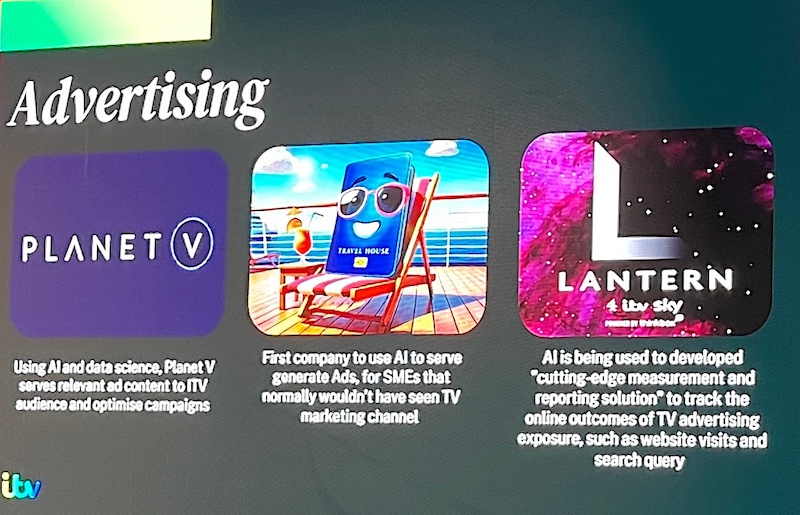
Areas of growth and/or efficiency identified in the CTO Roundtable and other IBC sessions include:
Better social media content
“AI is producing huge amounts of advertising content. Socials and YouTube are now being flooded with average ad content and it will only increase.”
Farnsworth has no doubt there are uses for AI in content production, but he sees the human element as being essential in the initial creation process. “The difference for human produced content is that it will be different from what’s fully created with AI.” Success does not come from either-or, it comes from using both. Once teams have the idea and the approach, they use AI for ideation and visualisation to move the original concept forward.
More product offerings
Using AI to multiply the amount of original content and to offer it in many languages and treatments has unlocked growth that companies would never have taken in the past, because the costs were too high. AI can now translate and modify content to offer multiple languages to different parts of the world or to minority segments of the mainstream audience.
“Multilanguage streams on YouTube is revenue we never would have had. It is niche consumption, but deeply important for those consumers.”
Improved marketing
ITV’s marketing department has experienced a “1000% increase in marketing productivity,” with quicker production of marketing collateral such as posters and social media graphics and improved search functionality of content for promo production.
Improved Internal Content Discovery
ABC’s Chief Digital and Information Officer Damian Cronan showcased the Australian national broadcaster’s success with internal AI functionality in it’s ABC Assist jornalism tool. “When we thought about where we’re going to spend our time and money investing in AI, we thought to start with an internal focus. How do we assist our staff, and then over time, think about how we augment the audience experience.”
The ABC’s large radio network of 68 stations, plus its television and digital assets generate “a huge amount of content.” ABC Assist used large language model AI technology to index and search all ABC content across its platforms and form its archives to assist journalists in preparing for interviews, identifying prior research of relevance, and understand historical coverage of topics.
Improved External Content Discovery
Audio and video recommendation engines can improve further by using AI. Consumption statistics mentioned in conference presentations show that audiences spend about 10 minutes (more for subscription video services such as Netflix) searching through content to find the show they want to listen to or watch. Some even abandon their search when they don’t find waht they want. This can be improved with AI.
If we don’t upgrade the recommendation engines, consumers will do it themselves outside our podcast and video platforms. Consumers will “use semantic search, that allows them to interact with content searching at a deeper level” than is currently provided by recommendation engines.
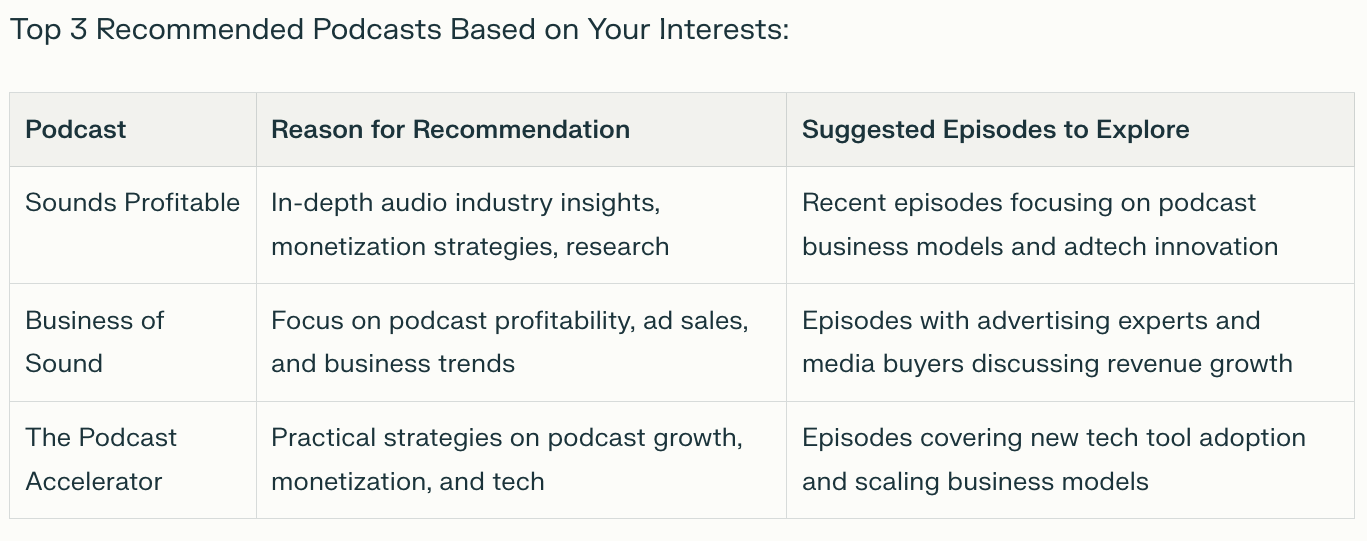
I tested this proposition by asking for recomendations from Perplexity. I asked this:
Find me 10 current podcasts about radio and podcasting in any language and prepare a summary of each. Then make a recommendation to me for the top three podcasts based on my interests. My interests are: audio technology, audio business structures and audio business profitability. Also identify the episodes I might like best in that podcast series.
It gave me a good recomendation and drilled down to specific episodes:
Platforms like ‘dwell time’ because they monetise it, but the rules are evolving. There is such a thing as bad dwell time, whcih is not helpful to media businesses because it cna lead to abandoned searches and user frustration. “Views, dwell time and downloads are a vanity metric. Fandom is a better measurement metric, how engaged are your fans with your content. The rules are evolving.”
The Creator Philosophy
Evan Schapiro championed multimedia creators for giving an insight to broadcast media companies into navigating the new media business environment.
“Creators are the new superstars… Passion and fandom are the tools of their success. Cultivate your company’s fandom,” he said quoting success stories from audio and video creators who have driven their podcasts and vodcasts to commercial success.
“The power will shift back to broadcasters if they embrace the creator philosophy,” he said.
Behind all this change, companies need to hold AI suppliers to account for accuracy, privacy and sustainable energy usage.
Other trends include:
- Structuring media curriculum
- Creators and working with YouTube
- Evolving car apps
- Untethered studio desk hardware
more on those soon.

Reporter: Steve Ahern is the publisher of this trade journal and the CEO of the training company AMT Pty Ltd.