
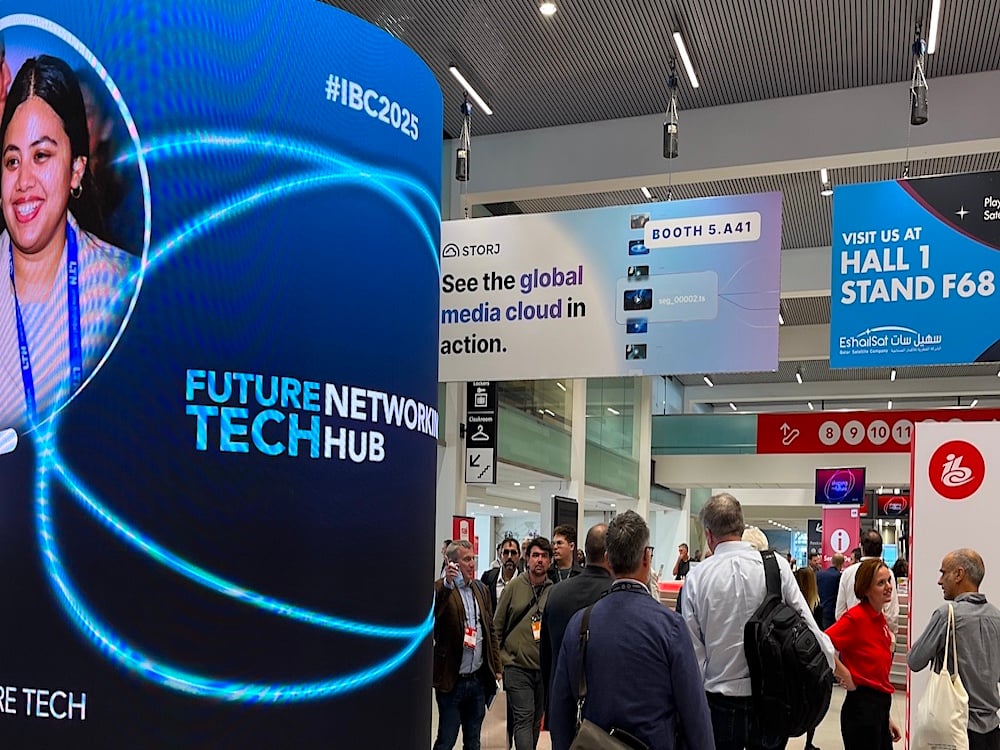
Steve Ahern’s second trend report from IBC.
Car manufacturers’ love affair with big in-dash entertainment screens may be cooling, and voice control will increase in importance for drivers and smart device users, according to people I spoke to at the annual IBC broadcast and technology show in Amsterdam.
One car entertainment system manufacturer told me the car industry “thought big screens were so cool,” when Elon Musk first introduced iPad-like screens in the Tesla. Other manufacturers began to copy them, but information from drivers is beginning to show that they do not use all the functionality of a big screen.
I tested this proposition by asking taxi and ride share Tesla drivers during my recent trip what they look at on their screen.
Most said they viewed the top left square (or right, depending on which side of the road they drive on) to see turn information and ‘now playing’ radio/music information, overlaid on the driving map if they are using navigation. They were consistent in their views that the other boxes were unnecessary or distracting. The most distracting from my anecdotal survey of a few drivers was the live illustrations of cars and trucks in the lanes around the car.
No doubt electronic screens are here to stay, but the preferred size and placement may emerge as a thin horizontal format from behind the steering wheel to the middle of the dash, not an iPad shape in the middle of the dash. The section behind the steering wheel will show speed, fuel and the usual driving telemetry, now in digital form, while the middle section will show entertainment options and driving maps. Heads up screen displays will also be integrated to show speed and turns.
Another exhibitor in the automotive entertainment sector believes voice control will become more valuable to drivers as a control mechanism for the minimalist screens. He believes AI voice recognition will improve the functionality to the extent that your car’s voice control assistant will be able to interpret driver intentions rather than just interpret specific commands, as is the case at present. If this scenario is correct, then it will be a consideration in the prominence debate and will also require the main radio entertainment system companies, Xperi, Radioplayer and Gracenote, to integrate voice control further into their systems.
Live broadcast radio continues to be an important requirement in cars, amidst all the other offerings now available. In Europe it is even more sought after due to the mandatory inclusion of DAB+ digital radio in cars.
Given this background, what might come next with the integration of AI and voice control in car entertainment systems, smart speakers and other smart devices?
My prediction is that interactive AI will deliver better options for drivers joining live radio streams through their voice commands. This is the scenario I think would initially be the most useful to drivers:
< Driver, mic button on > Play my local ABC Radio station.
< Car AI > You are driving through Gosford, do you want to listen to ABC Sydney or ABC Central Coast?
< Driver > ABC Sydney
< Car AI > Hamish McDonald is currently interviewing Ed Sheeran, do you want to join the interview in progress now, rewind to the beginning, or do you want to hear a news bulletin first? Say news bulletin, now, or rewind.
< Driver > News bulletin…
One station in Germany is currently trialling basic functionality similar to this scenario on smart speakers and their app. It works with streaming and DAB+ broadcasts
The missing link so far in achieving this next level of voice control functionality has been the inability of the voice control tools to understand our intention and use multiple methods to deliver it. We now have second generation AI tools that can deliver these goals: Generative AI using large language models to interpret intent, and agentic functionality to control multiple tasks in a sequence to deliver that intent.
I spoke with Broadcast Bionics innovator Dan McQuillan about this next stage in the evolution of AI voice control. He could immediately see the implications for cars, smart speakers and other devices such as smart watches.
We discussed the need for equipment flexibility for the next stage of AI integration into streaming and voice control.
“When it comes to this type of innovation we need to think like Silicon Valley engineers, not broadcast engineers,” said Dan.
“Broadcast engineers have been brought up to get things right and then set and forget their studios, rack rooms and transmission chain, because changing something might interrupt transmission continuity. This is important, but can slow them down when it comes to innovation. Flexible thinking is about active monitoring, fixing problems by routing around them, and being ready to swap out a faulting server, not repair it.
“I think of it like pets and cattle. We love our pets and will spend time and money on medicines and vets to keep them alive. Farmers breed cattle for food and profit, not love, if an animal gets sick they put it down. In this new technology environment, we need to treat our servers, studios and rack rooms like cattle, not pets.”
Harsh but realistic Dan !
On that note, there is a new approach to studio desks that I explored with Paul Dengate. More on that soon.
Both the automotive sources mentioned declined to be named in this article, because automotive companies are notoriously secretive about their innovations and strategies.
Steve Ahern reporting from IBC Amsterdam.