
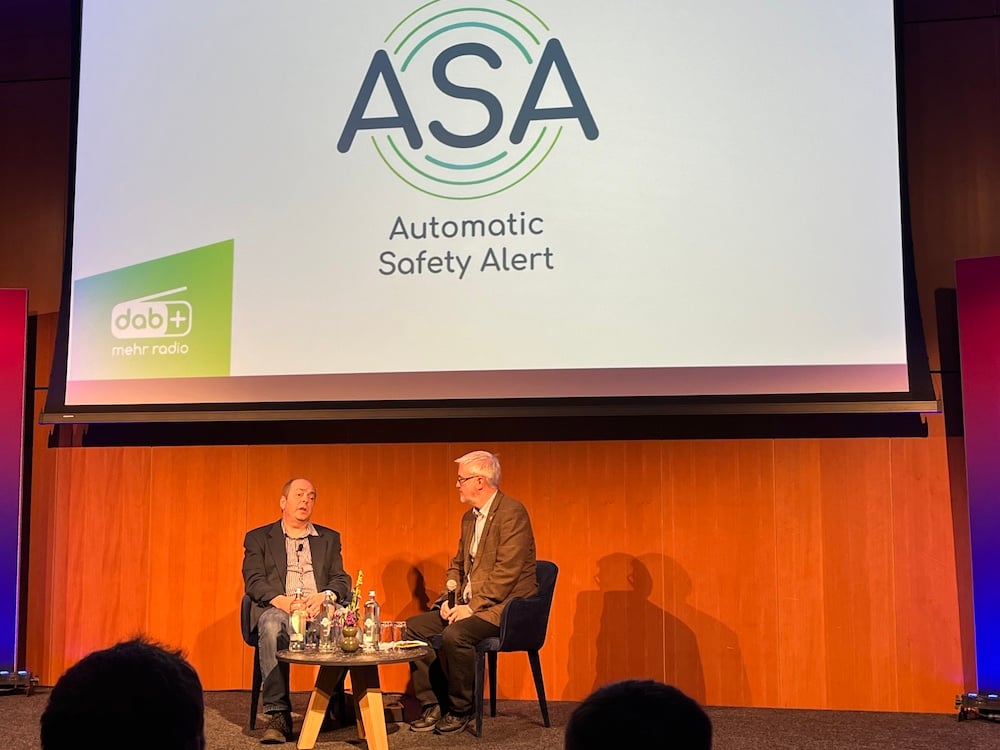
At the IBC conference in Amsterdam last week, WorldDAB demonstrated the new DAB+ Automatic Safety Alerts (ASA) system.
Explaining the enhanced feature for DAB Radios, Lindsay Cornell, Principal Systems Architect at the BBC and Chair of the WorldDAB Technical Committee explained that the receivers are geosensitive so that they will know where they are and only wake up if the emergency is in their location.
“We developed a standard with the greatest functionality across all receivers… they are certified through a testing lab,” said Cornell.
“The new ASA enabled receivers are coming into the shops over the next few months, showing the speed that the industry is reacting to the new standard and producing new receivers.”
About twenty receivers enabled with the new system are available immediately (see full list here).
In Germany, there is an emergency warning day each year when they test safety alerts across the country. This year the new DAB+ ASA system was used for the first time on the National DAB multiplex and some of the regional DAB broadcasters.
“They tried different techniques , some tests were live from a studio, some were prerecorded but triggered from studio, others were done as text to speech with preprepared messages delivered automatically.”
A website www.asa.radio is available to show where the alerts are available and to help tune the radio to the correct alert location.
Digital Radio continues to grow across Europe, with three new BBC national radio stations coming on air last week. There are two Radio 1 spinoffs . Radio 1 Anthems is for Radio 1 audience members “who are drifting older,” featuring music from the 2010s. The other new DAB+ stations are: Radio 1 Dance and Radio 3 ‘Unwind,’ which plays classical music for young listeners.
“They are designed to bring new audiences to BBC free to air radio,” said Cornell.
The conference session also heard updates on the progress of DAB+ through Europe.
David Fernandez Quijada, research director at South 180, presented a white paper examining the current state of DAB+ in Spain that examined public policy measures to increase the adoption of Digital Radio in Spain. “DAB+ increases certainty for broadcasters, equipment suppliers, audiences, retailers and advertisers,” he said, discussing the financial stimulus that more digital stations bring to the radio industry.
“150 million consumer radios have been sold. All new cars in Europe are mandated to have DAB as standard,” he said.
Bruno Cigrovski, from the DAB+ Network operator in Croatia explained that hsi country is celoebrating 100 years of radio.
“With a weekly reach of 80% of Europeans, radio and tv are considered essential infrastructure. DAB radio gives accessibility and sustainability with its free to air efficient broadcast model.

“The internet is constantly increasing its carbon footprint, while broadcast radio is reducing its footprint.
“It is an asset that strengthens national sovereignty. Digital broadcast radio is resistant to cyber attack and works any time in any weather, without buffering and bottle necks. Terrestrial broadcasting offers the ability to deliver regional and local content, in contrast to internet, which delivers contnet from everywhere.”
In Croatia daily radio listening is about 64%. About 12% listen via the DAB platform, which has 98% coverage of the population. There are 150 FM and 11 DAB channels in Croatia.

French Transmission provider Towercast began in the 1980s when private commercial radio exploded. Now there are 0ver 600 private commercial stations. 46% of broadcasting in France, 684 stations, are private commercial DAB+ stations. New formats introduced recently include childrens, thematic formats (eg Jazz) and specialised content.
The coming Phase 3 rollout will add 300 more transmitters and extend broadcasts to 20 new areas. The French are working on ‘service following’ functionality so that cars can stay with their station when moving to a new mux coverage area.
Reporting: Steve Ahern