

A range of views on disaster media activities were shared at RadioDays Asia.
Fabian Randerath (pictured), the Fijian Broadcasting Corporation’s (FBC) Resilience Committee Chair shared experiences coordinating the activities of Fiji’s national broadcaster, before, during and after the island nation’s regular threats from extreme weather conditions.
He described how the national broadcaster works with the SENDAI Disaster Risk Reduction Framework, a global blueprint for disaster risk and recovery.
Sendai recognizes that the State has the primary role to reduce disaster risk, but that responsibility should be shared with other stakeholders including local government, the private sector and other stakeholders such as broadcasters.
UNDRR is tasked to support the implementation, follow-up and review of the Sendai Framework.
In conjunction with the Sendai initiative, FBC has created a disaster resilience recovery plan. “We needed to increase our internal capacity and raise awareness of resilience,” said Randerath , explaining the broadcasters role in broadcasting preproduced content to prepare for disasters and make people aware to keep themselves and the nation safe.
Fiji’s most common natural disasters are primarily related to its location in the tropical cyclone belt and the ‘Pacific Ring of Fire,’ leading to frequent tropical cyclones, floods, and landslides, often exacerbated by climate change. Because the island is located in the ‘ring of fire,’ earthquakes and tsunamis also pose a risk to Fiji.
FBC is using AI research tools to identify steps to take. The project also identified the role of leadership to unite everyone, gain momentum and get teams moving in the same direction.
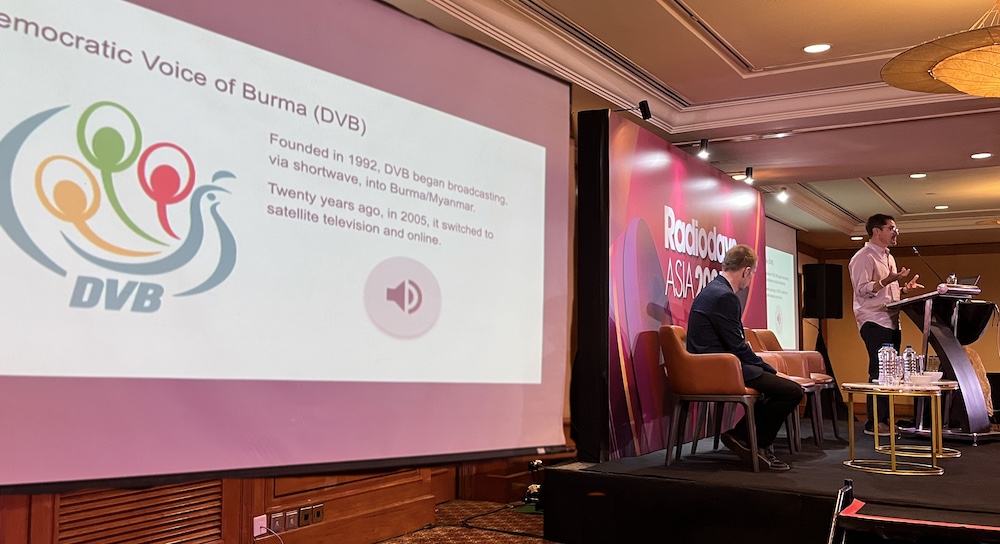
Speaking about a different type of disaster, Adam Bemma, the Managing Editor of Democratic Voice of Burma (DVB) outlined how his organisation continues to broadcast into Myanmar (Burma) despite the military coup.
Democratic Voice of Burma was founded in 1992 via shortwave radio in response to the first military coup in 1989. After a brief period of democracy under Aung San Suu Kyi, another coup took place in 2021 and forced DVB into exile. The service has now evolved to be delivered via satellite tv and online. They are also using podcasts.
“DVB is a trusted media brand associated with pro-democracy movement, but it is important for us to be independent now, so we criticise all equally,” said Bemma.
“State run media accuses DVB of being ‘a sky full of lies,’ but we are just providing independent news. The BBC and other independent news organisations are also being denigrated.”
Thanks to the Trump cuts to international media aid funding, Radio Free Asia and VOA are no longer broadcasting into the region, making it even more important for DVB to continue its work.
“Citizen journos connect with us and send data and pictures for the channel.
“Listening to audio in public spaces is safer than watching tv, because you could be seen and arrested if you are watching tv.”
Mistam Abz, the Director of Program and Production at Radio Republik Indonesia (RRI) gave a round up of how the national broadcaster handles emergencies across the sprawling archipelago of over 17,000 islands.
RRI is Indonesia’s “independent non commercial national broadcaster for Indonesia, with 212 channels in 49 languages.
RRI uses the emergency wake up functionality in DRM broadcasts for warnings. The national broadcaster participates in national disaster communication frameworks such as Indonesia’s National Early Warning System (SNPDK), which integrates various governmental agencies and broadcasting services. It is a key partner in relaying alerts and real-time disaster information to affected populations, and preparedness broadcasts help increase public preparedness and provide life-saving information during emergencies like tsunamis, floods, and earthquakes.
Reporting & Pictures: Steve Ahern