
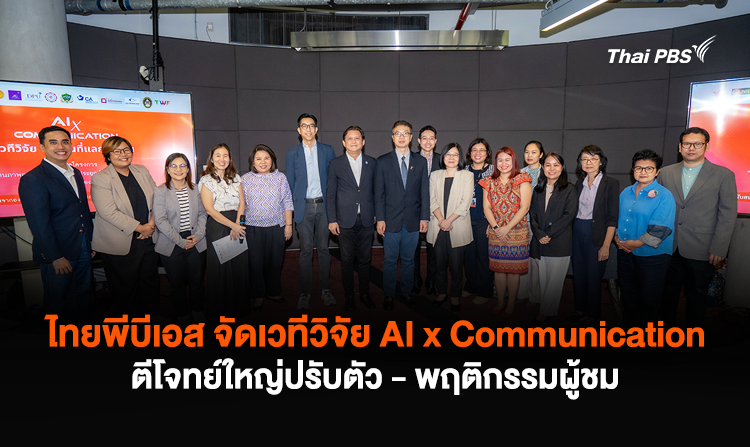
The Thai Public Broadcasting Service (PBS) organized a research exchange forum titled “AI x Communication: A Research Forum, Opening Space for Exchange” under the research project “Status of Knowledge and Application of Artificial Intelligence in the Communication Context of Thai Society,” supported by the Thai PBS Public Media Research and Development Center.
Headed by Assoc. Prof. Dr. Sermsiri Nildam, Dean of the Faculty of Management Sciences, Chiang Rai Rajabhat University, the project was also led by researchers from various media and technology circles.
Piset Chiyasak, TBS Deputy Director for Administration, presided over the opening ceremony. He said that this forum was organized to create a platform for knowledge exchange on communications in an era where artificial intelligence (AI) plays a crucial role in the media industry, particularly in news production and consumption, as well as public participation. The forum also reflects changes in the roles of journalists, researchers, academics, and current mass media. Research under this forum covers three key areas:
1. Policy and Organizational Adaptation to AI: Adoption and Governance of Artificial Intelligence in the Journalism Industry
2. Audience Engagement and AI Influence: Concepts about audience engagement and AI influence
3. Case Studies & Real-world Application: Real-world case studies and applications of AI in the media, education, and social communication industries.
Asst. Prof. Dr. Ekapol Thienthavorn, a researcher at Thammasat University’s Faculty of Journalism and Mass Communications, on the topic of “The Use of Artificial Intelligence in the Media Production Process of Thai News Organizations,” stated that AI impacts all industries, including the media. This led to the research, which compiled 85 pieces of knowledge about AI in the news industry and interviewed three media organizations. Preliminary interviews revealed that AI use stems from individual efforts, not organizational policy. There are no standards for its use, such as using AI for transcription or voice typing. AI is merely an assistant, not a creator. Writing skills are a skill of journalists. Standard guidelines have been drafted as a central criterion, demonstrating rapid adaptation. However, ethical concerns remain. Therefore, it is widely agreed that AI is a double-edged sword, with both benefits and drawbacks. Therefore, a proper AI ecosystem is essential.
Asst. Prof. Dr. Pitaksak Tisapak, School of Global Studies (International Program), Thammasat University, a researcher on the regulation of the use of artificial intelligence in mass communication, stated that the research framework for studying how the guidelines and models are regulated in foreign countries has three levels of concept: 1. Self-regulation 2. Co-regulation 3. State-regulated. Case studies were selected from three countries: Singapore, Canada, and the European Union, where common points were found, such as responsibility for using AI and protecting personal data.
Asst. Prof. Rawiwan Sappin from Thammasat University presented on the topic “Artificial Intelligence and Media Creation by Content Creators,” discussing the application of AI in the media industry and the interest in Content Creators, a group in which AI is continuously playing an important role. The reason for the interest in this topic is because AI is developing rapidly and is beginning to influence the media industry, especially the influencer group, which has a high influence on society. Data from Linktree statistics indicates that in 2025, Thailand had as many as 9,000,000 content creators, or approximately 12.86%, and the Thai content creator market has an annual growth rate of 25-30%.