
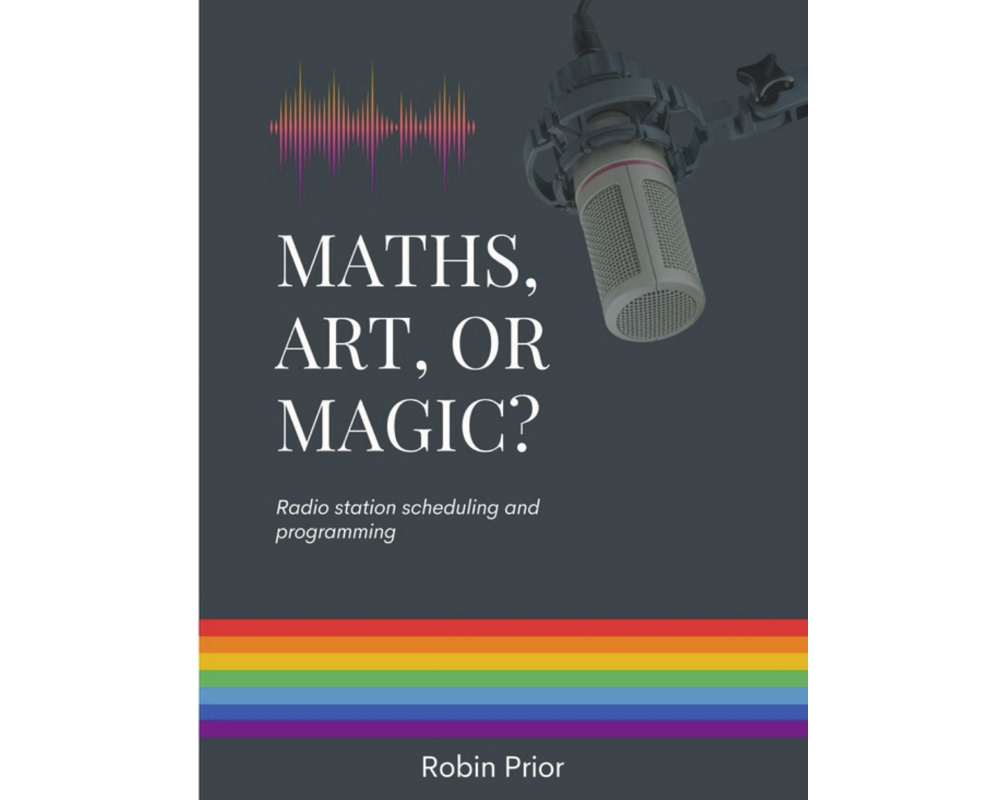
Book Review by Steve Ahern.
In his new book, Maths, Art or Magic, Robin Prior has gathered his experience from over 40 years working in radio to publish a guide that should end up in every music scheduling office in the world of radio.
I have used many music scheduling and playout systems, made many mistakes along the way, and finally got the hang of it. I wish I had this book at the beginning of my music scheduling journey. It gives plenty of practical tips on how to use your scheduling system to the max, but what I like is that it also explores programming philosophies and quotes the thoughts of some great programmers from all around the world.
Robin is based in Africa and his experience in many African countries gives a rich understanding beyond just the maths of scheduling. He also brings in viewpoints from well known programmers.
At the beginning of the book Robin reminds us that the art of great radio must be balanced by the business priorities, then he quickly gets to the heart of great music programming – the music rotations. “We must decide how often our listeners will hear the same Hot song… The answer is, A LOT! Once it has become familiar and listeners stop listening to that song so much… it enters the Core listening, you should hear it once or twice a week.”
He discusses how some songs drop right out of the music universe quickly, while others stay in a sleep category and are brought back from time to time as a memory maker, because they are just great timeless songs. He puts Led Zeppelin’s 1971 hit Stairway to Heaven in that category, along with Dire Straights’ Sultans of Swing and Queen’s We Will Rock You.
He gives this sage advice to programmers who react too quickly to listener feedback: When listeners complain that a song is played too often, “they are really saying that you are playing the wrong song too often…” They would not complain if you were playing the song they love too often.
Listeners should hear a hot song rotated every couple of hours, every core song should be heard at least once every five days, and a ‘memory maker’ song once every two or three weeks, advises Robin. A song follows a standard product lifecycle bell curve: Introduction, Acceptance, Maturity, Decline.
In the research section of the book, he explains the importance of the P1 audience in music research and the value of other audience segments. Social media has also become “an integral part of our broadcasting matrix” and can be an important source of music research information. He urges programmers to keep up to date with the technologies that can deliver music research data that they can use to make their playlist decisions, and to use the RCS Media Monitors Aircheck database to track music played across their market.
As well as practical and detailed tips about how to make your music scheduling system sing, he also talks about other elements of the station, such as the value of competitions in building a cumulative audience.
Scheduling “is a smoke and mirrors brew of maths, art and instinct,” says Robin, urging hard work and attention to detail to make your music rotation software deliver its best results. Constructing program clocks means understanding: the time of day; what the listener is doing right now; how the program can enhance their experience at this moment; and what the competitors are doing. His definitions of music formats, with examples of songs for each format type are useful references that readers will go back to every time they need to reformat the station or start a new one.
It’s not just about music, Robin also talks about the value of good presenters to connect a station with its audience and every aspect of the station..Everything that goes to air “is precious” he says, “don’t waste even one minute” of each programming hour. His ten rules of music scheduling towards the end of the book and the related tips are also highly valuable and will be surely used as a training resource and a reference for programmers and music schedulers everywhere.
Robin Prior, for 23 years, was the RCS Africa VP and worked for RCS for over thirty years in Africa and worldwide, including a seven-year stint in the USA, serving as Support Manager, Master Control Product Manager, and International VP. He was also responsible for the initial product architecture and design of RCS’s Zetta Digital production and playout system. In April/May 1992, he installed the first ever RCS Digital Audio playout system in the world at SABC’s Radio Five.
My copy of Robin’s book is already well used and annotated.
Maths, Art or Magic? Can be ordered here or via most good online booksellers.
About the Author:
Steve Ahern is the publisher of this trade journal and CEO of the international training company AMT Pty Ltd.